

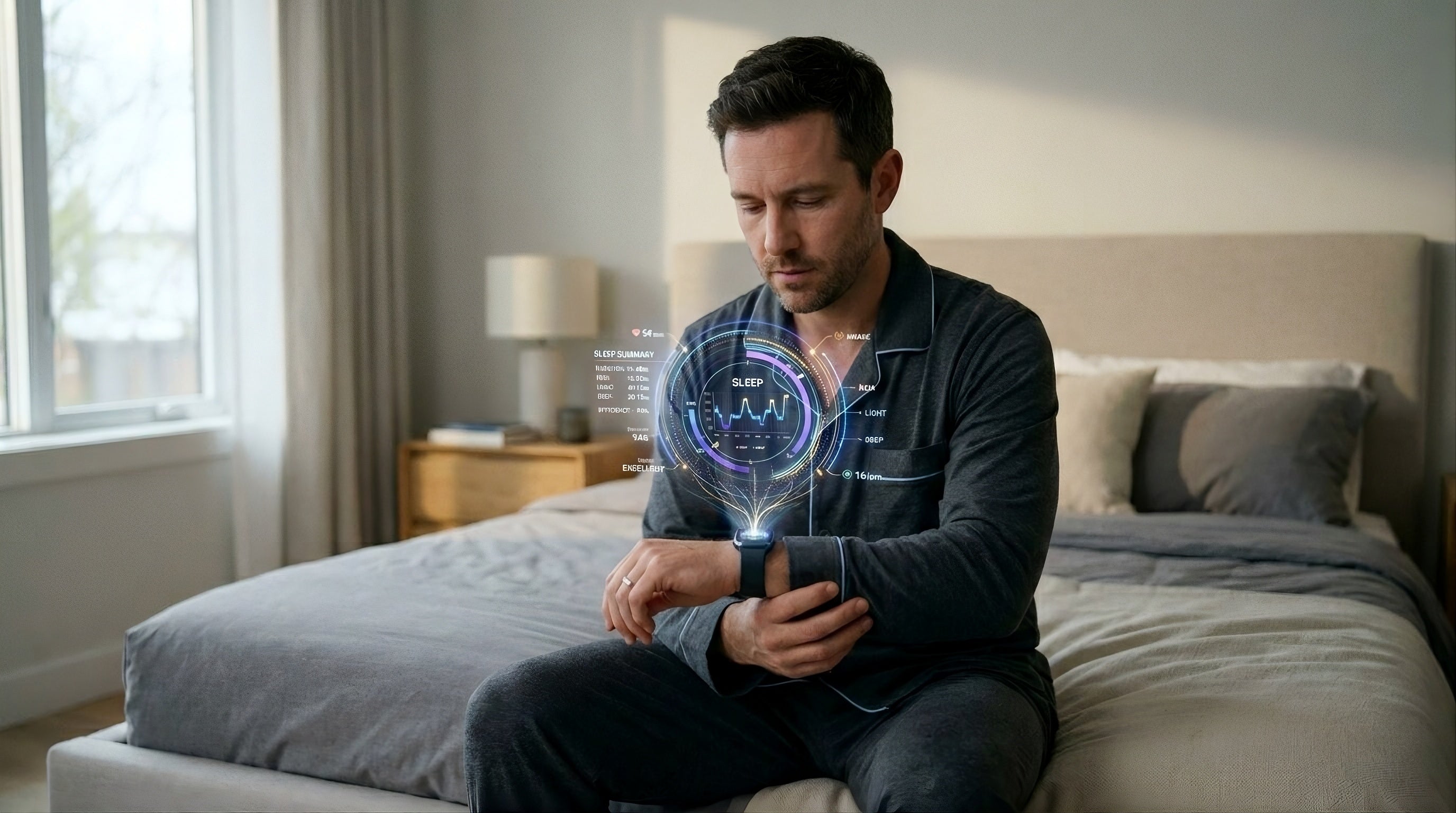
You wake up feeling refreshed, but your smartwatch immediately ruins the mood: “Sleep score: 58. Recovery insufficient.” Suddenly, you no longer feel quite so well-rested. Sleep is just one of many metrics that smartwatches, rings, and other wearable devices track every day. But how valuable is this data? And is it sometimes better to listen to your own body rather than an algorithm?
Smartwatches Are Not Medical Devices
Wearable technology bombards us with data—it measures and evaluates our heart rate, sleep, stress, recovery, heart rate variability, blood oxygen saturation, and VO₂max. These are generally useful insights that can help us monitor our health and even work toward improving it.
However, we must remember one crucial fact: most smartwatches and fitness trackers are not designed to diagnose health conditions. They rely on optical sensors (PPG), accelerometers, and algorithms that generate estimates from the data they collect.
Metrics that are difficult to measure directly should therefore be interpreted with caution. At the same time, it can be useful to observe whether these values are trending upward or downward over time. In fact, the greatest benefit of wearable devices often lies not in absolute accuracy but in their ability to track long-term trends.
What Is Worth Tracking?
1. Resting Heart Rate
If you could track only one metric with your smartwatch, resting heart rate would be a sensible choice. Generally speaking, a lower resting heart rate is desirable because a consistently lower resting heart rate is often associated with better cardiovascular fitness.
On a day-to-day basis, however, it can be even more valuable to monitor changes relative to your normal baseline.
For example:
-
an elevated nighttime heart rate for several days in a row,
-
a combination of increased heart rate and fatigue,
-
or unusually high readings during recovery
may signal insufficient recovery, overtraining, elevated stress levels, or the onset of an infection that may not become physically apparent for several more days. Resting heart rate can therefore serve as a highly useful early warning signal.
2. HRV Trends
HRV (Heart Rate Variability) refers to the variation in time between consecutive heartbeats.
At first glance, that may sound strange. Shouldn’t the heart beat regularly? In reality, a certain degree of variability is a sign of a flexible and well-adapted nervous system. Higher HRV is generally associated with better recovery and greater resilience to stress, while lower HRV is often linked to overload, illness, or sleep deprivation.
Systematic reviews suggest that modern wearable devices can measure HRV reasonably accurately under certain conditions, particularly during rest or sleep. Accuracy tends to decline during movement.
Once again, the trend matters more than the specific number. HRV varies greatly between individuals. A value of 35 ms may be excellent for one person and concerning for another.

3. Overall Physical Activity
Step count, daily activity, and total movement volume are among the most practical metrics offered by smartwatches and rings. They often reveal a simple truth: we generally tend to overestimate how active we are. We think we’ve been active, but in reality, we spent most of the day sitting. Sometimes it’s useful to face the facts.
What Should Be Taken with a Grain of Salt?
1. Sleep Stages
How much deep sleep did you get? How much REM sleep? How much light sleep? This is where things become more complicated.
Sleep is typically measured in a sleep laboratory, where brain activity, eye movements, muscle tension, and other parameters are monitored. Smartwatches cannot measure these directly. Instead, they rely mainly on movement, heart rate, and heart rate variability. They are relatively good at estimating when you fell asleep and when you woke up, which allows them to calculate total sleep duration with reasonable accuracy.
However, they are significantly less accurate when it comes to identifying individual sleep stages. So if your watch shows 52 minutes of deep sleep one night and 1 hour 38 minutes the next, don’t treat those figures as absolute truth.
2. “Stress Score”
Continuous stress monitoring is typically based on HRV and heart rate. However, the human body is not that simple.
While low HRV can indicate stress, there are exceptions. For example, after an extremely intense workout, HRV may be reduced even though you subjectively feel great and full of energy. Conversely, high HRV does not necessarily mean that you are perfectly rested and recovering optimally. In some cases, very high HRV can even occur during physiological overload, such as in certain elite athletes.
For this reason, treat stress scores as general indicators rather than objective facts.
3. Calories Burned
This is probably one of the least reliable metrics. Basing your weight-loss or weight-maintenance efforts on it is therefore not the best strategy.
Calculating energy expenditure depends on numerous factors, including age, sex, body composition, activity type, movement efficiency, and individual metabolism. These variables are difficult for a smartwatch to fully account for. As a result, wearables can significantly overestimate or underestimate calorie expenditure.
So if your watch claims you’ve just burned 1,127 kcal, consider it a rough estimate rather than an exact figure.

4. VO₂max
VO₂max is one of the strongest indicators of physical fitness and longevity. However, there’s a catch: true VO₂max can only be accurately measured through an exercise test with respiratory gas analysis in a laboratory. Smartwatches do not measure VO₂max directly—they only estimate it based on heart rate, pace, power output, age, and other variables. Even so, they can still be useful for tracking trends over time.
So if your watch reports a VO₂max of 45 today and 49 six months from now, you have probably improved. Whether your true value is actually 47 or 51, however, cannot be determined without laboratory testing.
Why Is VO₂max So Important? This metric represents the maximum amount of oxygen your body can utilize during intense exercise. As such, it indirectly reflects the condition of your heart, blood vessels, lungs, and muscles. Numerous studies show that people with higher cardiorespiratory fitness have a lower risk of premature death, cardiovascular disease, and several other chronic conditions.
Can It Be Improved? You can improve your VO₂max primarily through regular physical activity, especially exercises that engage large muscle groups and elevate heart rate. You don’t need to train like a professional athlete. Simply increasing your daily movement and incorporating a few endurance workouts each week can gradually enhance VO₂max.
The most effective approach usually combines:
-
a higher volume of low- to moderate-intensity exercise (your aerobic base),
-
occasional higher-intensity intervals,
-
and strength training, which helps maintain muscle mass and overall performance.
How Can Nutrition Support It? Regular endurance exercise remains the foundation. However, certain nutrients may support processes related to tissue oxygenation, oxygen utilization, and energy production. These include:
-
nitrates, naturally found in beetroot, arugula, and spinach;
-
iron from red meat, organ meats, legumes, and seeds (supplementation is most beneficial for individuals with a confirmed deficiency);
-
and omega-3 fatty acids from fatty fish, which support cardiovascular health and may positively influence certain adaptations associated with endurance training.
After 30, NAD+ levels drop sharply – and with them, energy and the cells’ ability to repair themselves. NAD+ Prime replenishes it so your cells can produce energy and regenerate like they did when you were younger
The Biggest Risk? Trusting Your Watch More Than Yourself
Smartwatches and rings have one unusual characteristic. They can subtly change the way we perceive our own bodies—or whether we perceive them at all. If your watch tells you that you slept poorly, you may start feeling tired even if you woke up full of energy.
This phenomenon even has a name: orthosomnia. It refers to an unhealthy obsession with optimizing sleep based on wearable-device data. And guess what? The result is often more stress and worse sleep.
Similarly, a watch can take away the satisfaction of a great workout if it labels the session as ineffective. Suddenly, the feeling of accomplishment disappears. Yet in everyday life, the subjective feeling of being rested or having done meaningful work is often more important than a few points difference in a sleep score. Data should complement our experience, not replace it.
How to Use Smartwatches Wisely
-
Focus on trends rather than individual days.
-
Pay attention to patterns and the impact of both intentional and unavoidable changes—such as a new training plan or a particularly stressful period at work.
-
Prioritize long-term habits.
-
Don’t let an algorithm decide how you should feel.
Key Takeaways
Smartwatches can be incredibly useful tools. They can motivate us to move more, alert us to insufficient recovery, or reveal patterns we might otherwise overlook. And if they help us become more active or go to bed earlier, they have fulfilled their purpose perfectly.
At the same time, they are not all-knowing.
The most accurate metric remains a combination of data and personal judgment. Because the ultimate goal is not to achieve perfect numbers on a screen—it is to have enough energy, a well-functioning body, and a life that you can fully enjoy.
Sources:
-
https://pubmed.ncbi.nlm.nih.gov/29668452/
-
https://pmc.ncbi.nlm.nih.gov/articles/PMC5624990/
-
https://www.mdpi.com/1424-8220/21/5/1562
-
https://pmc.ncbi.nlm.nih.gov/articles/PMC7509623/
-
https://pmc.ncbi.nlm.nih.gov/articles/PMC9213394/
-
https://www.ahajournals.org/doi/10.1161/CIR.0000000000000461



Share:
Circadian Rhythm: Why It Matters When You Sleep, Eat, and Exercise?
Coffee and its alternatives: How to gain energy wisely, not just on borrowed time?