

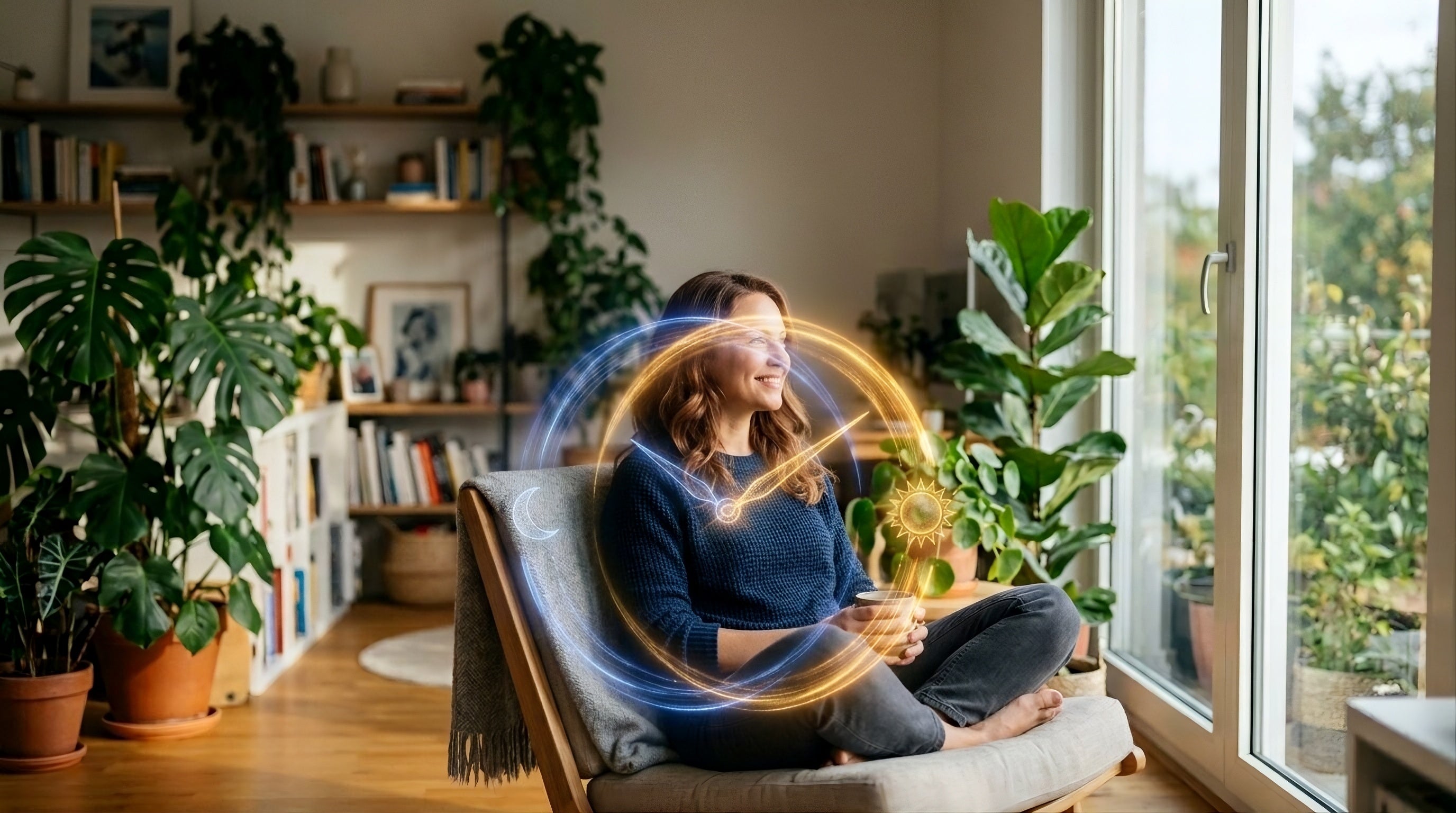
In the pursuit of having more energy and living a long, fulfilling life, we often overlook one of the most fundamental biological principles: the human body runs on natural internal clocks. And when we do not follow them, chaos takes over—our metabolic health, recovery, and physical and mental performance all fall out of tune. So how can we get in sync with our circadian rhythm?
What is the circadian rhythm?
The circadian rhythm is an approximately 24-hour biological cycle that regulates most of the body’s important processes—sleep, wakefulness, hormone production, body temperature, digestion, and metabolism.
Its main “conductor” is the suprachiasmatic nucleus (SCN). This group of neurons located in the hypothalamus continuously receives information about the intensity and colour of light from the retina and uses it to synchronise the rest of the body.
Today, we also know that the brain is not the only part of the body with its own biological clock. These clocks are found in virtually all tissues and organs —in the muscles, liver, fat tissue, and intestines. And for the body to function optimally, all of these “clockworks” need to be aligned.

Why should you care about the circadian rhythm?
From an evolutionary perspective, we adapted over millions of years to the cycle of day and night. Only in the past few decades have we spent our evenings under artificial light, worked shifts, or fallen asleep with a phone in hand. And it does not serve us well.
Research shows that long-term disruption of the circadian rhythm is associated with a higher risk of:
-
metabolic disorders,
-
obesity,
-
insulin resistance,
-
cardiovascular disease,
-
mood disorders,
-
poorer recovery and sleep quality.
That is why, when it comes to sleep, we no longer emphasise only its duration, but also its quality and timing. The same applies to food, movement, and light exposure, where when and what kind of light we are exposed to each day is essential.
How can you tell when your circadian rhythm is “out of sync”?
Occasional fatigue after a demanding week is normal. But if, over the long term, you:
-
wake up tired in the morning even after getting enough sleep,
-
cannot fall asleep in the evening even though you are exhausted during the day,
-
experience marked energy slumps during the day,
-
struggle with intense late-night hunger,
the issue may be a disrupted circadian rhythm.
Objectively higher-risk groups include people who travel frequently across time zones or work shifts, as well as parents of young children. But it is also easy to throw our internal clocks off simply through a hectic lifestyle or a lack of awareness of the most common factors that negatively affect the circadian rhythm.
How can you synchronise your biological clock?
In everyday life, we usually cannot control absolutely everything, so ideal conditions are rarely possible. But in most cases, a few basic, relatively small changes are enough to make a meaningful difference.
1. Start your day with light
The strongest regulator of the circadian rhythm is light. Shortly after waking—ideally within the first hour of being awake—step outside for 5 to 10 minutes, or at least open a window and give your eyes contact with natural daylight. Even an overcast sky will serve you far better than typical indoor lighting.
Morning light exposure helps suppress any remaining production of the so-called sleep hormone melatonin and kick-start wakefulness. At the same time, it synchronises your biological clock and influences the proper timing of evening tiredness. In other words, how well you sleep at night is already being decided in the morning.
2. Dim the lights in the evening
So light works a bit like a start button—one we do not want to keep pressing in the evening. Yet that is exactly what many of us do, and we even call it relaxing. A common habit that lowers sleep quality is endless scrolling on your phone or watching films in the evening. Screens and LED lighting emit light with a blue component, which signals to the brain that it should stay alert.
For evening lighting, replace bright white light with warmer sources and, two to three hours before bed, limit time on the computer and phone. Try swapping these activities for a book, or at least use screen night modes or special red-tinted glasses that filter out part of the blue light.
3. Go to bed at roughly the same time
Your biological clock runs on a schedule—and the body is usually happiest when it does not have to rewrite that schedule every day. So if you want to support it, there is one clear answer: consistency. Studies support this too: irregular sleep is associated with poorer health outcomes regardless of sleep duration itself.
Of course, you do not need to fall asleep at exactly 10:03 p.m. every day, but if you go to bed unusually early one night and at 1 a.m. the next, the body struggles to orient itself. Catching up on sleep over the weekend is not the best strategy either.
4. Eat during the day, not at night
Another important timing signal is food. When we eat, processing food becomes the body’s top priority, and other less essential functions temporarily take a back seat. A large meal late in the evening can therefore disrupt nighttime recovery processes.
Metabolism is also not equally efficient throughout the day—insulin sensitivity is typically higher in the morning and earlier part of the day, which means the body can handle even a larger carbohydrate load more easily and process it more efficiently. In the evening, this ability naturally declines.
In practical terms, this means:
-
try to consume most of your calories during the day,
-
do not eat right before bed,
-
limit late-night snacking,
-
give your body a longer overnight break from food.
If you extend that overnight “fasting window” a little further, you may also benefit from so-called intermittent fasting , which can support the body’s natural cellular renewal.
► You can read more in our article on autophagy.
5. Move at the right time
Although enough physical activity is important for good-quality sleep, intense evening training can actually make it harder for many of us to fall asleep.
So if you find yourself tossing and turning in bed after an evening workout, try moving more demanding training sessions earlier in the day. If you feel like moving in the evening, opt for a walk or a calm yoga session instead.

6. Do not overdo caffeine
Caffeine blocks receptors for adenosine—a substance that builds up during the day, calms the nervous system, and creates a feeling of tiredness. Caffeine remains active in the body for roughly 5 to 7 hours, and even longer in more sensitive individuals. So even a coffee you seemingly drank ages ago—say, during an afternoon break—can still negatively affect your ability to fall asleep.
For better sleep, try to avoid caffeine at least 8 hours before your planned bedtime. And keep in mind that it is not found only in coffee, but also in tea, energy drinks, and cola-based drinks.
How is the circadian rhythm connected to longevity?
When people hear the word longevity, most imagine expensive tests, complex protocols, or the latest biohacking trends. In reality, something much simpler may have a greater impact: a regular routine.
Aligning with our biological clock is one of the essential foundations of quality sleep, during which many processes take place that are linked to tissue repair, immune system regulation, hormonal balance, and cellular maintenance.
Disruption of the biological clock also affects processes associated with inflammation, metabolism, and cellular aging. That is why understanding and respecting the circadian rhythm is now considered one of the core pillars of long-term health.
Did you know…
…that getting enough of certain nutrients also plays a role in sleep quality?
For recovery and the proper functioning of the nervous system, the following are important, for example:
- Magnesium – helps reduce both mental and muscular tension.
- L-theanine (an amino acid naturally found in green tea) – is often associated with a feeling of relaxation without excessive drowsiness.
- Lemon balm, chamomile, and other botanical extracts – have been used for generations to support relaxation.
Highly absorbable magnesium, L-theanine, and carefully selected herbal extracts can also be found in DeepRest, designed for calmer evenings and deeper overnight recovery. For more energy during the day, consider synergistic revitalising supplements such as LifeCharge instead of caffeine-based stimulants, as they may provide much steadier results.
Fall asleep faster, sleep through the night, and wake up truly rested. Deep nighttime recovery without melatonin – no morning grogginess, no habit-forming effects Ageing won’t stop. But its pace is decided today – in your cells, not in the mirror. Every month you postpone is a month you never get back

What should you take away from this?
Regular sleep, enough morning light, less light in the evening, sensible meal timing, and daily movement are among the best-researched ways to align your biological clock with how your body is naturally designed to function.
And that is often where the true potential of long-term health lies—not in extremes, but in consistent habits that we can maintain for years.
Sources:
- https://pubmed.ncbi.nlm.nih.gov/31768006/
- https://pmc.ncbi.nlm.nih.gov/articles/PMC5449130/
- https://pmc.ncbi.nlm.nih.gov/articles/PMC5995632/
- https://www.nature.com/articles/s44271-024-00159-5
- https://pubmed.ncbi.nlm.nih.gov/31938759/
- https://pmc.ncbi.nlm.nih.gov/articles/PMC5272178/



Share:
Autophagy: How to Support the Cells’ Natural “Cleanup System”?
Sleep quality, calories burned, a good feeling. What can (and can’t) you learn from a smartwatch?