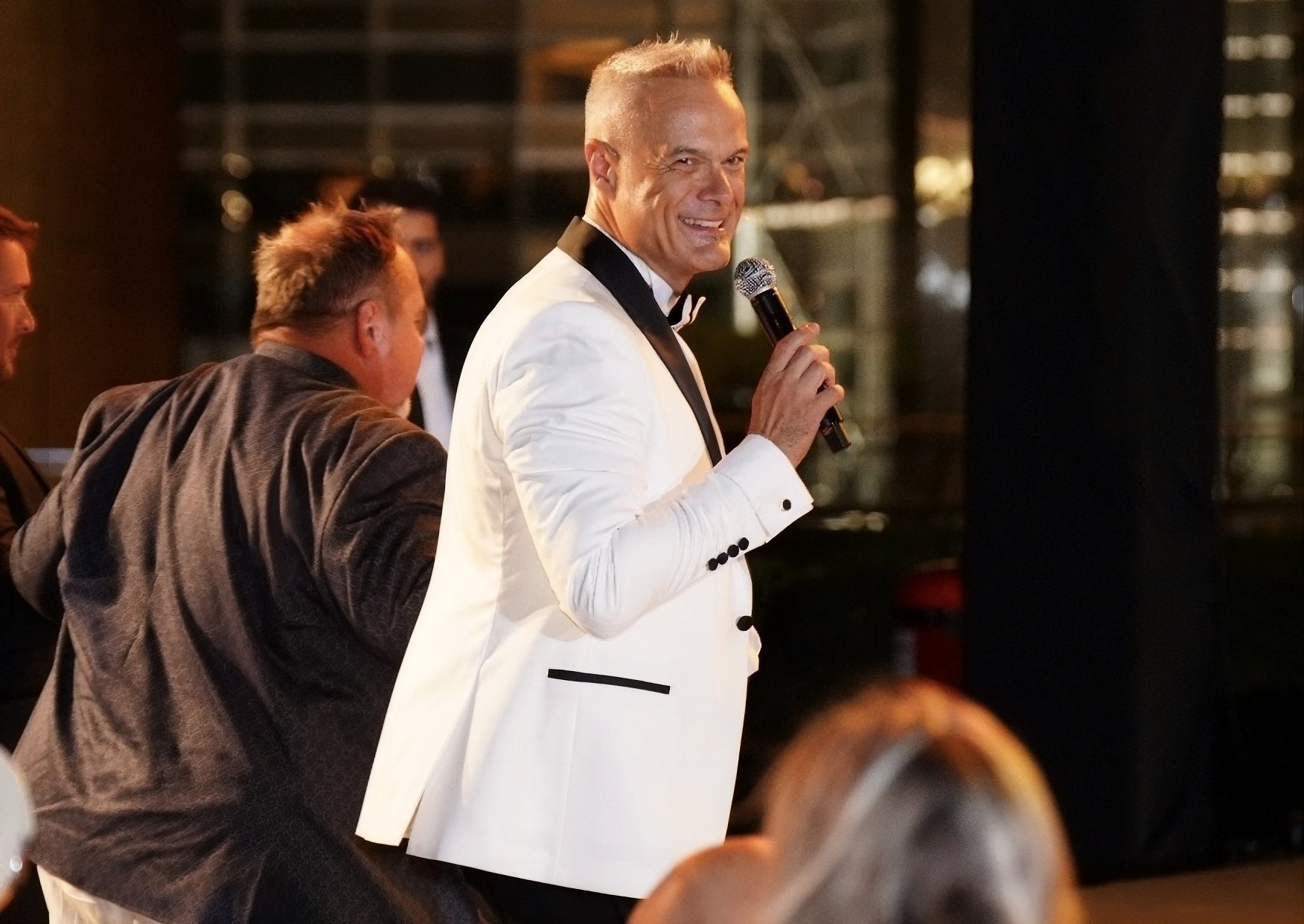
“In my thirties, I worked hard, but definitely not smart,” says successful music producer, manager, and screenwriter Jaro Slávik. Three back surgeries, injuries, and years of intense work and athletic performance taught him that self-love is the key — and with it comes care for both body and mind. What does he do for his health today, how did Madonna inspire him, and which vices has he still not managed to leave behind?
Your working life can hardly be described as calm. What helps you manage it most?
I don’t think my working life is unusually hectic. Maybe it’s a bit unconventional compared to other professions — I organize events on three continents or help entrepreneurs, manage artistic careers, and occasionally devote myself to stand-up shows. But I live a balanced life with plenty of literature, sport, and time in nature.
But back to your question: I have four main rules. The first is enso/wabi sabi. When things aren’t working, I don’t force them — just as the Buddhist enso circle should be painted in a single stroke, work should have flow too. The second rule is 45 minutes of focus and 15 minutes of rest, during which I go for a walk, pick up a book, or even grab dumbbells or a jump rope. Third, I delegate as much as possible and limit the number of decisions I have to make during the day. I simply try to make my life as simple as possible. And the last rule is that I place great emphasis on rest, recovery, and good nutrition — including supplements. Since I’m a former competitive athlete, I’ve been taking various vitamins and minerals since I was 28. Sometimes the body needs more than it can get from food alone.
When you know you have a demanding day ahead and need to function at your best until the evening, do you have your own “operating manual”?
In general, I rely on balance. Good rest is the foundation, but movement energizes me too. Every day — whether I’m in Europe or Dubai — I start with a walk or a run. Not on a treadmill, but outdoors in nature, in the sun, in the fresh air. I try to think about the day ahead: what’s waiting for me, what I want to do and come up with. I want to start in creative mode, not reactive mode, so I don’t respond to messages or emails in the morning.
Intermittent fasting also helps me — a hungry mind is more creative. On the other hand, if I don’t want to do anything during the day, I’ll have a croissant and a cappuccino. :-) Otherwise, though, I try to keep my diet balanced too — for example, by adding nutrients I might be missing: creatine for sport, AAKG because of my back surgeries, and now also everything NOZONO offers. That’s where I found what suits me. From NAD+ to magnesium. Everything I used to have to search for and combine myself, I now have ready in comprehensive formulas.
Cells don't repair on the go – they repair at night. NAD+ Prime fuels them through the day, DeepRest gives them the quiet to finish the job. A full 24 hours, not just the morning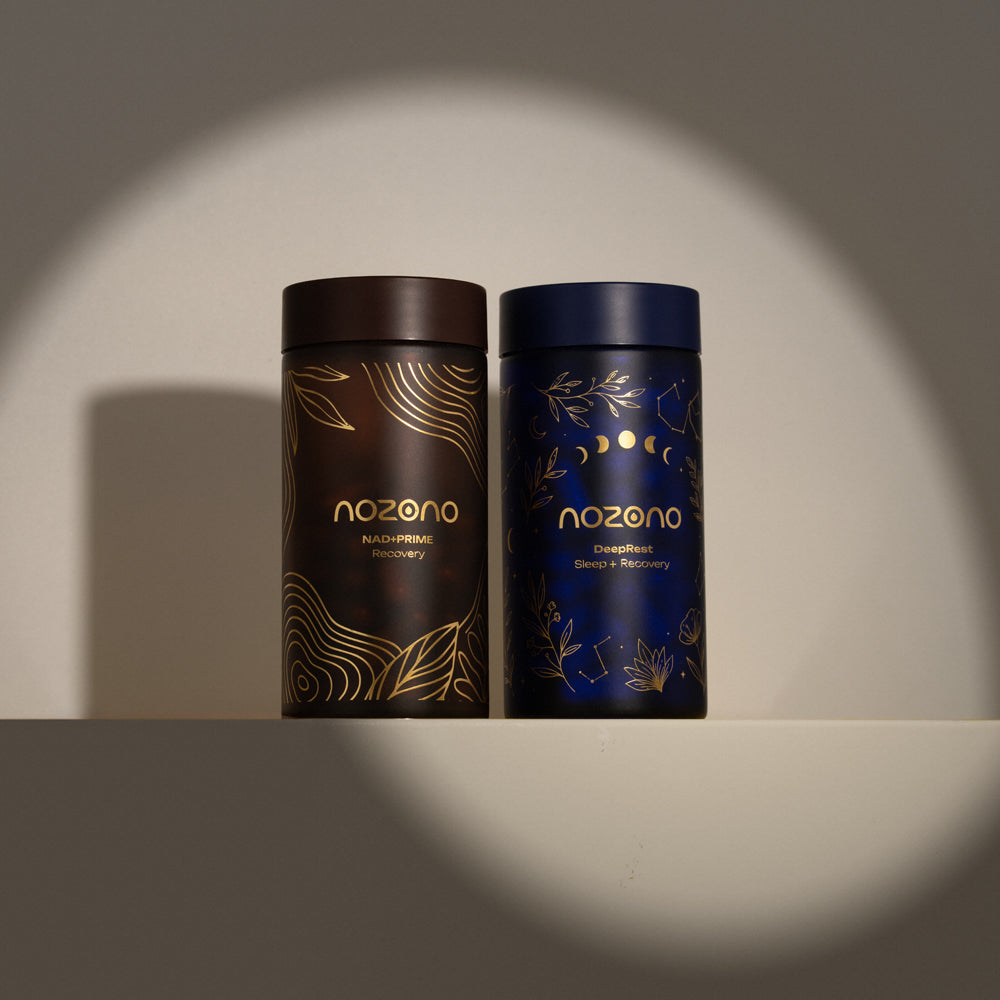
When did you first realize that we need to care for both body and mind if we want them to serve us for as long as possible?
I looked after my body on an ongoing basis. But I also went through very dark periods when it simply wasn’t possible at all, and I was declining both mentally and, of course, physically. The last real aha moment came after moving to Dubai, just before turning fifty. I realized that of all the people and characters I ever wanted to portray or be, in the end I can only be myself. And I have to learn to accept and love that person. Which is not easy at all. You have to find the strength to forgive yourself, accept yourself, and begin working on yourself. And only when you truly begin taking care of your mind can you take care of your body too. Unlike all possible roles and personalities, we only get one body.
Do you feel that as a society we are also coming to a similar realization — that we ourselves are, to some extent, responsible for our health?
That responsibility always lies mainly with us. We just didn’t know it, because for 40 years there was a silent agreement here that the communist state would take care of everything and the people living in it didn’t have to (and weren’t supposed to) deal with anything. On top of that, nothing is easier than drinking alcohol, eating unhealthy food, binge-watching series, taking drugs… in our civilization, taking care of yourself is actually something anti-intuitive. But people are starting to realize it. They are learning to love life, even when it hurts sometimes.
But it always depends on role models too. I was incredibly lucky to be able to work with Madonna. In the entertainment industry, there is probably no bigger hard worker or sharper mind. She began taking care of her health and using supplements sometime before thirty, so she wouldn’t have to suffer later in life. When we were doing her concert in Moscow in 2007, she spent hours in the gym, but she also read a lot and took care of her people.

Throughout your career, you’ve come across a huge number of brands, products, and people trying to sell something. What can still convince you today that it’s not just well-executed marketing?
One of my teachers and mentors, the legendary Seymour Stein, music manager of Madonna and the Ramones, always said that the foundation of a successful singer is the song. And his wife, New York real estate magnate Linda Stein, used to say that the foundation of a good property deal is location. I believe that a successful product must above all be high quality. So quality is the absolute foundation. That cannot be faked.
The second aspect is trust. It’s clear that not every quality product will break through in a competitive market. But it’s equally clear that every poor-quality product will fail sooner or later. Closely connected to that are the people behind the scenes, the people behind the product, its creators. If they can clearly communicate what the product is for, who it is for, and what its benefits are, they earn my trust more easily.
What did you need to verify before agreeing to become a NOZONO ambassador?
I consider myself a modern person and I always keep track of what people are talking about, so the longevity trend didn’t escape me either. I also turned fifty recently, so I felt I needed to start supplementing in a more comprehensive and sophisticated way. But my local patriotism and the people behind the NOZONO brand also played an important role.
I had offers from foreign companies, and in the past I worked long-term with a Canadian-Swiss brand, but as I said, what won me over above all was the combination of a comprehensive world-class product, the creators of NOZONO, and the fact that it is a homegrown brand. And most importantly, it works. After just a few weeks, my recovery improved and my sleep score, according to my smartwatch, is above 90 percent. So I can genuinely recommend it with a clear conscience.

Do you do anything for your health today that you considered unnecessary in your thirties, but now wouldn’t give up?
In my thirties, I was overseeing 17 countries. On top of that, I was a young father and still playing basketball. I trained in two phases and sometimes even three times a day. I worked hard and not at all smart.
Today I place much greater emphasis on recovery and mindfulness. I think about what I do and what I eat. I’m no longer going to have fries or a baguette at two in the morning. In fact, I’m usually asleep at two in the morning now (unless I’m flying or traveling on a night train). I still train twice a day, but intelligently — running or cycling in the morning and weights in the evening. But in intervals and at high intensity. No long hours and no enormous weights. I believe that long-term supplementation helps me too, and that my routine and thoughtful nutrition will allow me to stay this active at least until I’m 70.
On the other hand, do you have any habit you know doesn’t really suit you, but you still haven’t been able — or perhaps didn’t even want — to give up?
I don’t like talking about them, but unfortunately there are still quite a few. I can still really go overboard with food. Thankfully, I quit smoking. Alcohol and I aren’t really friends anymore either, and other substances even less so. I’ve come a long way, but I’m still not yet the person I’m trying to become.
Alongside your demanding work, you also stay actively involved in sport. What have you learned about recovery the hard way — by overdoing it at some point?
You don’t have to listen to your body — you can overtrain, you can push through pain. But then you can’t be surprised when the body reacts. For me, it meant three back surgeries, a ruined ankle, and a broken foot at the end of my career.
That’s why today I approach my body like a house I live in and want to live in for as long as possible. So I listen when something is leaking somewhere, not working, or needs repairing. And I seal and repair…

People often talk mainly about what we lose with age — energy, speed, resilience. What do you think we gain instead, and what is worth noticing with gratitude?
Perspective and composure. And also a sense of humor, so that we can cope with our own decline. Ideally, though, also the wisdom and ability to think about how to prevent it.
Personally, however, I don’t feel any of the losses mentioned. I prepared for turning fifty, and now I’m continuing to prepare.
What helps you take the passing years in stride?
I don’t really notice them. I don’t let aging in. I simply try to live in a way that keeps me full of energy for as long as possible, and I believe it will stay that way.
Jaro Slávik is a Slovak producer, screenwriter, and artistic manager with more than thirty years of experience in show business. He has worked with a number of major figures in global pop culture and has been active on the international scene. He is also known as a judge on talent competitions.
Today he lives in Dubai, stays active in sport, and is interested in health and longevity.

Share:
A guide to (healthy) ageing: What happens to the body and how to slow ageing down?
Quality sleep for energy-filled mornings. What makes DeepRest different from ordinary magnesium?